Living in an era of digital maps and apps, it is often hard to know what is the best mapping product to use. And if paper maps have become obsolete.
I wanted to share with you a few map tips that I have learned over the years.
My first tenet:
- Always bring a paper map and know where you are on it. (So of course, no! paper maps are not obsolete!)
- I am a big fan of using both GPS and paper maps. GPS units are great for pinpointing where you are exactly and navigating in dense trees or confusing terrain, but paper maps give a much better feel of your overall location relative to the surrounding area and relative to your trip as a whole. Paper maps are much easier to see how drainages and mountain ranges fit together.
- I am also a fan of paper maps because they act as another kind of map – a map of my past, present, and future experiences. They represent places I have been and memories I’ve had, X’s for good campsite locations, and potential route scribbled in pencil in excitement haste. They have stains and small rips from being repeatedly fawned over and used to dream about the next adventure. I am quite fond of them and never leave home without them.
- What kind of maps do I like to carry? Well, depending on the route and how well I know the terrain (and any time I am doing extensive off trail navigation), I like to use 7.5 minute quadrangles. 7.5 minute quads have a 1:24,000 scale meaning that any measure of the map, if expanding 24,000 times, would match the actual environment. For example, an inch of the map equals 24,000 inches in the field. These maps encompass a relatively small area but show great detail. You can find quad maps at many regional gear stores, Forest Service offices, or maps stores. I also like mytopo.com.
- I also carry the Cairn Cartographics Maps. They produce, among other things, Bob Marshall Wilderness maps – both north and a south half option. These are excellent topographic maps that show trail miles + they are water resistant + they are from a local company. These are excellent for calculating trail miles, seeing the over all route (particularly when the route covers several 7.5 minute quads), and for naming the mountains I see in the distance. Sometimes, if I know a route quite well, I will just bring the Cairn Maps and leave the quads at home.
My second Tenet:
- The print map and GPS combo is ideal for multi day trips.
The combo of the GPS, 7.5 minute quad, and the larger scale Bob Marshall map have proved to be the right combo for specific navigation and overall route information. The GPS provides your exact location and helps you navigate in dense trees/confusing terrain, the quad gives you a larger scale view of a relatively small area, and the bigger Bob map is best for orientation and looking at overall route.
A bit about GPS’s: GPS’s a great because they show you exactly where you are on a particular trail or if you are not on a trail, what you position is relative to where you are going. This exact location marker can be crucial to off trail navigation. You can also track your daily miles and elevation. Or is you are needing to navigate to a point (say a particular campsite), the GPS will help you navigate to that exact point.
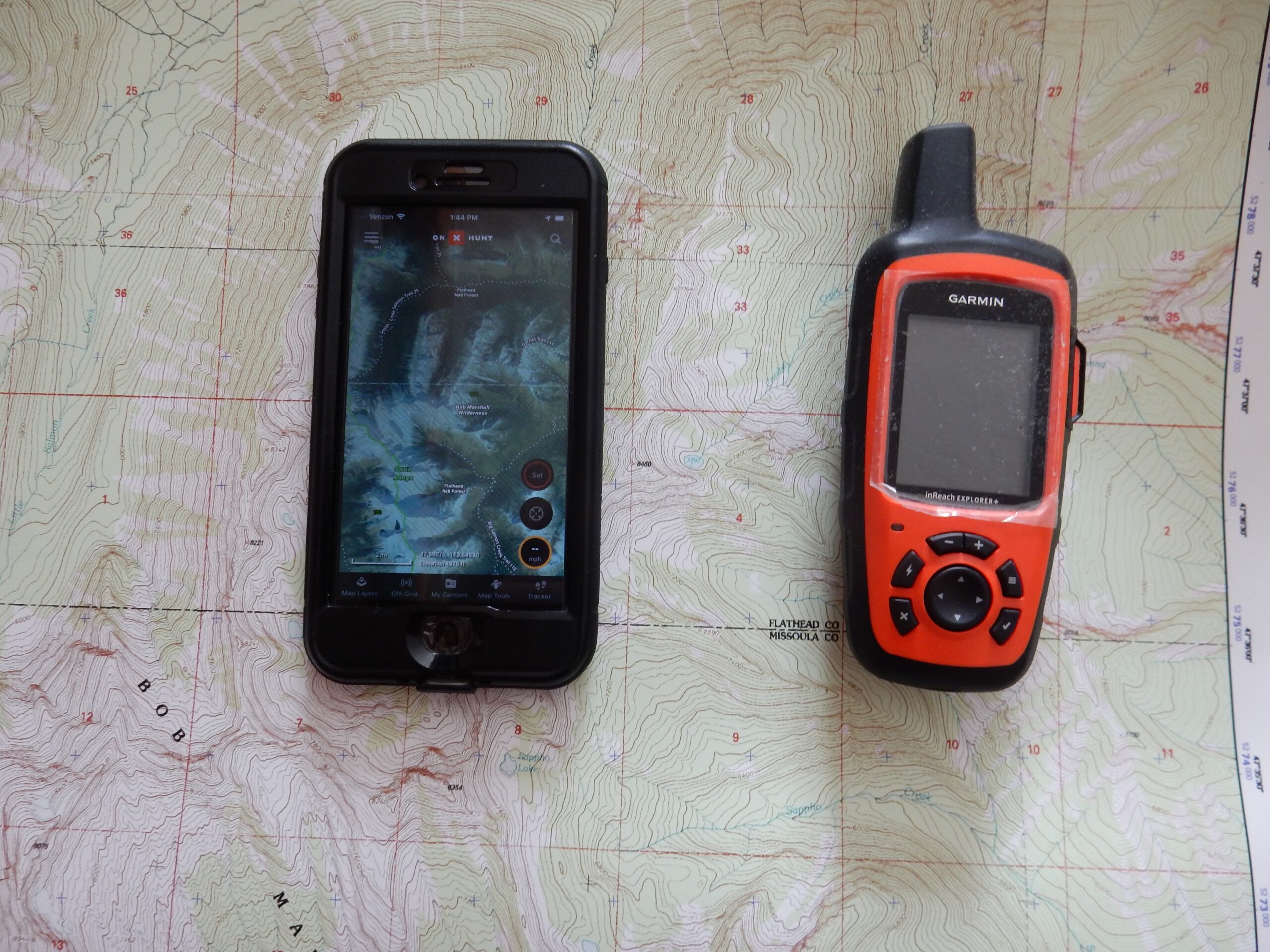
What kind of GPS to Use? There are a lot of them out there, and most of basic models will operate similarly. The bottom line is – there are lots of options and as long as you know how to use it, it will work just fine. We use a Garmin GPSMAPS 64 with the Montana/Idaho maps chip and the Garmin InReach Explorer. The Garmin GPSMAPS 64 (the more basic of the two) is slightly more accurate (as long as you purchase the topo map SD chip for the state you are in) and has better trail and tracking information. And is less expensive because you do not have to purchase an annual plan. However, the Garmin InReach Explorer has satellite texting capabilities. The texting capabilities act just like normal cell phone to cell phone texting (and you can set up Bluetooth so you can use your phone instead of the device). We like this product because it doubles as an emergency communication device.
BUT, a third option exists. If you do not want to buy a GPS, and you are comfortable taking your phone into the backcountry, there are several apps you can download that function very similarly to a GPS. I have the Gaia GPS and onX Hunt app on my phone, and there are several other companies out there that can do this. The only catch is that you need to download the specific area to your phone before you leave cell coverage so the GPS tracking can function while your phone is off line. Some of the apps are free or have a free basic app level, and those that you pay something for are inexpensive.
There are apps that will actually download the topographic map to your phone; however, I am still a fan of carrying the paper map in case something happens to the device or the battery runs out and you don’t have a solar charger. Plus, it is easier to orient with a bigger map instead of a small screen.
I am going to soap box about SCREENS a little. There is something counter intuitive and a bit disturbing about walking down a trail in a beautiful wilderness setting and looking at a screen. One of the reasons to do a backcountry trip is to disconnect from the digital world. Having the GPS on your phone or another GPS is great but does require screen time. I have occasionally gotten myself pulled into the “let’s check the GPS every five minutes” mode, and it really has hampered my ability to disconnect. I like to keep that in mind and only use it when absolutely necessary.
Some over all navigation pointers:
As you go through an area, periodically check the paper map to orient yourself. Make sure you know where north, south, east, and west are and how the drainages run together. Sidenote – make a habit of occasionally looking behind you. In the event that you need to go back down the trail you just hiked up, it is good to have some familiar landmarks. A trail in the reverse direction can look very different.
It is a good rule of thumb to always have a backup map incase something happens to the navigation tool you are using – so by having a couple of paper map options plus a GPS, you’ve got your bases covered.
Learn more about navigation on a Dropstone Trip!
On a Dropstone trip, we do all of the navigation, but we provide everyone with route maps (courtesy of our friends, Cairn Cartographics), and carry maps for everyone to look at and orient themselves with. We are happy to provide a few pointers in navigation as we travel through the woods. We encourage folks to learn more about navigation because we love maps and because we think it adds to the wilderness experience to really understand where and how we travel through the mountains and valleys of the great big Bob. There’s no better place to learn than along the trail with an experienced Dropstone guide.