Category: Uncategorized

  • 2022 Trip Release Timeline and Details

    2022 Trip Release Timeline and Details

    Dreaming of an early morning coffee along the banks of a clear, wild river? Or of gaining that final ridge before the sky opens up and you can see peaks and valleys in every direction? Join us on a multi-day stock supported hiking trip in Montana’s Bob Marshall Wilderness or Snowcrest Mountains for the ultimate backcountry experience. 

    Our 2022 wilderness hiking adventures will be posted soon. Trips will be available to view on-line on Monday, November 29th.  Booking begins at 9 am MST on Wednesday, December 1st, 2021. 

    A few highlight trips to note include a new Backcountry Yoga and Hiking Retreat, a grand traverse of the Iconic Northern Chinese Wall, and a journey into the wild and seldom traveled Snowcrest Mountains. 

    A few changes for the upcoming season:

    • All hiking trip reservations will be accepted on-line only.  The hunting reservation form is still a PDF to download.  
    • We will have trips posted for two days prior to booking to allow folks to ask questions and to think about their options before signing up. 
    • No reservations will be accepted before 9 AM Mountain Standard Time on Wednesday. That means if you fill one out before then, it does not count. 
    • Reservations are not confirmed until you get an email from us. 
    • We have decided to limit each trip to 8 guests.  We feel slightly smaller groups really enhance the wilderness experience and provide a higher quality trip. As a result, our prices have increased to reflect the smaller group size. 

    We’re excited about our line up this year – it includes some of the most rugged and beautiful country we’ve explored yet. There’s a little bit of something for everyone – challenging trips that include off-trail travel with scrambles up to remote peaks and more relaxed trips that take in the spectacular sights at a more moderate pace. We can’t wait to share these trips with you.  View trips on November 29th at https://dropstoneoutfitting.com/trips/. If you have any questions before the 2022 trip release, feel free to drop us a line. 

  • Spring 2021 Updates

    Spring 2021 Updates

    Greetings from the Rocky Mountain Front!  We hope spring finds you happy, healthy, and spending time outside enjoying the warmer weather. We are looking forward to the upcoming season and to exploring the Bob Marshall Wilderness with many of you. We are in full preparation mode for the Summer 2021 season. Whether cooking, shopping, riding new horses, or going through gear, there’s plenty of work to do. 


    We both enjoyed our winters. Yve always looks forward to the downshift of fall and winter.  More time spent inventing things to do with her boys, skiing as a family and catching up with friends and projects.  


    Maggie spent quite a bit of time skiing and recreating. She also worked for a local business doing soil sampling for area farmer, and spent time lambing again which brought her great joy.  In February, she bought a new (BIG) horse that she’s had fun getting to know the last few months.  


    A Few Dropstone Updates:

    • We have updated our Covid – 19 Procedures.  Please take a look at our Trip Information Packet online for the latest. Regardless of your vaccination status, we will continue to take precautions regarding Covid – 19. 
    • We booked in record timing for this season, and we have had more requests for waitlist additions and private trips than ever before.  The pandemic has created an increased drive for people to get outside.  We expect the mountains to be a bit busier than usual this year, so we will maintain good trail and campsite etiquette. Also, we will continue to strive for minimal camping impact to reduce the strain of the increased use on the resource. 
    • We are currently booked until 2023 for private trips. We will give first priority of private trip requests to those who have been with us on trips in the past. 
    • Look for 2022 trips in early December of 2021.  We will send out a newsletter in early Fall with more info. We will have more public offerings for trips in 2022 than we did for 2021. 
    • In an effort to maintain the quality of our trips and of your wilderness experience, we will be capping all public trips next season to 8 guests.  This will result in a slight increase in prices to compensate for the decrease in group size, but we feel this change will help maintain the vision we have for our business. 
    • This year, we are adding a couple new faces to the Dropstone family of helpers and employees including Maddie Herbert, who originally hales from Michigan but has found her way west to work with horses and explore the mountains, and Violet Bechtold, who attends Choteau High School and will be helping with trip turnaround logistics and learning the ropes at Dropstone.

    We look forward to seeing or hearing from you this summer.  Whether or not you are able to join us on a trip this season, we wish you a summer of dirty hiking boots, quality time spent in the woods, and a never-ending lust for all things wild. 


    Happy Trails,


    Maggie and Yve 


  • Staff Profile: Corlene Martin – Hostess and Cook Extraordinaire

    Staff Profile: Corlene Martin – Hostess and Cook Extraordinaire

    If you have ever been on a Dropstone trip, then you’ve met Corlene.

    You’ve seen her beautiful house and immaculately landscaped garden and eaten her delicious meals. Corlene’s food, home, and indomitable spirit are cornerstones in the Dropstone world.  Corlene is a class act, and I got a chance to catch up with her last week to learn more about the woman behind the myth, legend and brilliance. 

    Corlene grew up in Choteau.  Like many small town kids, she couldn’t wait to get out. And get out she did.  In true wanderlust fashion, Corlene lived in many places in the west once she left Choteau including San Francisco, Spokane, Alaska, and Seattle.  In one six year period, she moved 18 times.  She held a variety of jobs and has always been easy going, flexible, and capable of almost any task.

    Eventually, she decided to come back to Choteau and move into the house her mother lived in once her mother passed away. She had moved so many times that she decided she wasn’t ever going to move again.  That was 1998.  Even though she never dreamed of moving back to Choteau, she is very glad she did.

    Once back in Choteau, she worked a variety of jobs at many local businesses and non-profits including the Old Trail Museum, the Abstract office, a few working and guest ranches, several different outfitters, the Montana Wilderness Association, and the Sonoran Institute. She then “retired” (although all of us that know Corlene know she will never truly retire – she is always helping someone figure out how to decorate their house or volunteering for a local organization or re-landscaping her garden).  It was in 2015 that we started working with Corlene, and we are beyond grateful for the huge roll she plays in making our trips successful and tasty. 

    Corlene has spent more than her fair share of time in the mountains as well. She cooked in the wilderness for 35 years, starting in her mid 20’s.  Some years it was for just a few trips a season, and other years, she would cook for the entire season.  During her tenure as a camp cook, she worked for 8 different outfitters, and all but one of them operated in the Bob Marshall Wilderness. 
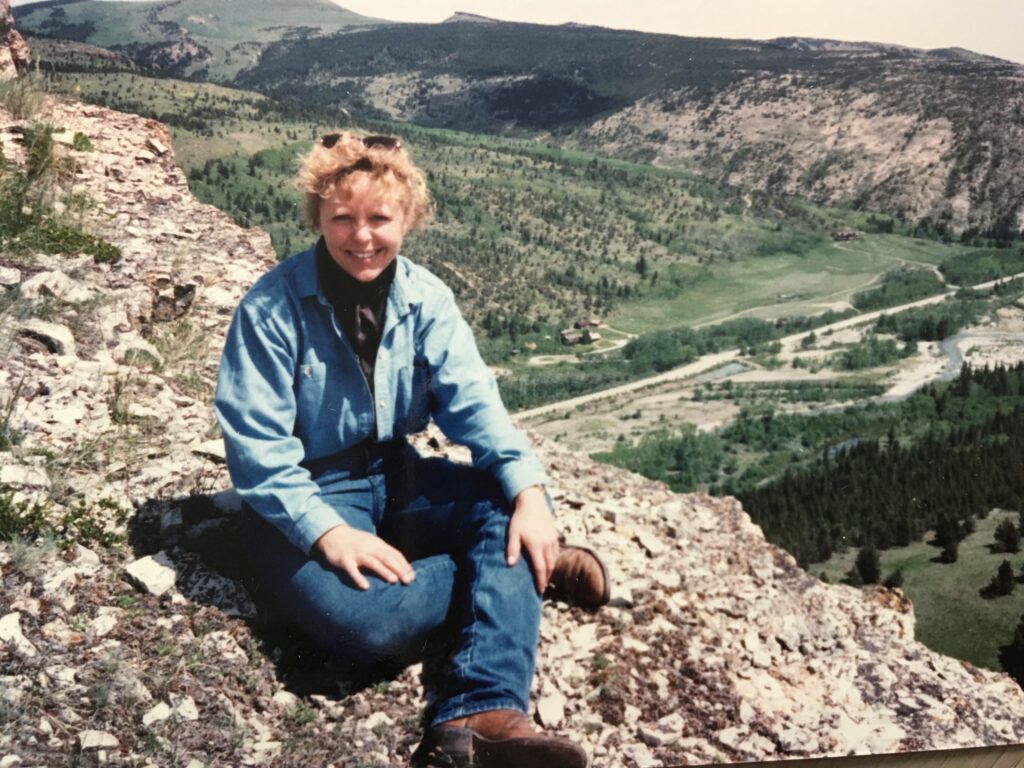
    The first outfitter she worked for was her friend Chip Gollehon.  On those trips, she learned how to cook in the backcountry from Chip’s mom, Janette.  When she started, she would never have thought of herself as a cook. Her mom was a good cook, but she didn’t want to do things she considered “girl stuff” back then including typing and cooking. But she soon realized that it’s one thing she could always do in the mountains and someone is always looking for a good backcountry cook. For her, cooking in the backcountry went hand in hand with wanting the wilderness experience. Plus, working for different outfitters allowed her to experience different areas in the Bob. 

    While Corlene never had any formal training on horseback, she started riding in first grade with her friend Leslie Gollehon. Once she became a backcountry cook, she was often in charge of leading the guests from one location to the next.  She remembers once that the person she was working for had drawn the directions to the next camp on her lunch bag – she just had to make sure the guests didn’t see her peaking at the brown paper bag for directions.  While she had many adventures via horseback including people falling off or horses getting turned around, it somehow always worked out.  

    Her favorite place in the Bob is the Trilobites because of all the “mop head” anemones that bloom there. She admits she was never big on remembering the names of mountains or drainages, but she could remember which hillside would have her favorite flowers and when they would bloom.  She was more into the “micro” wilderness experience than the “macro” world. Or as she said, “Don’t get me off the trail.”

    She worked in the Bob in 1988 and remembers valleys choked full of smoke and reroutes on several trips due to trail closures.  She remembers riding out of hunting camp on several occasions in belly deep snow. Or trips that had days of rain, where it was hard to get dry and the horses would slide down the trail in the mud. While inclement weather and events are not always pleasant, they are part of the experience. She says, “When you go back in the mountains, you have to be prepared for what the mountains dish out at you.  In the end, some of the best stories are from adverse conditions.”
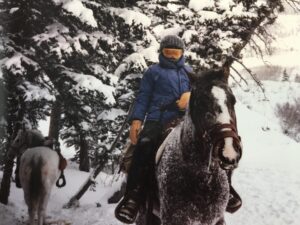
     

    She has seen an evolution in backcountry cooking as well. She remembers once bringing in a whole chicken to cook. She knew how to cook it but didn’t know how to cut it up, so the outfitter she was working for had to show her how.  She remembers when a lot of the cooking gear was composed of the old and worn out pots and pans from the lodges and homes of the outfitters, some partially broken or ill equipped to be used on a wood stove. This added another elements of finesse needed to cook a good meal in the mountains. Over time, cooking has evolved and become easier as gear and menus have changed. 

    One of her favorite parts about cooking in the mountains or for Dropstone is doing the organizing and planning of food and thinking about the ease of cooking it in the backcountry.  She prefers to do her own menu but has cooked for operations where they would also supply the menu too. One pointer she shared was to never use Dream Whip in eggs if you run out of cheese or dairy.  A lesson learned the hard way. 

    Working for Dropstone is perfect timing for Corlene.  While she loved working in the wilderness, she now prefers the comforts of home, a stove with a thermometer, indoor plumbing, Pandora, and air conditioning.  When I asked her which Dropstone meals she liked the most, she said (in true Corlene fashion) that she likes all of them. Especially Chicken Marbella and the Pork Loin with mustard sauce. Spaghetti is one of the favorites too. Flavors are important and she is now cooking more exotic than meals she used to cook. She likes to cook new and different things.  She used to not like to cook for vegetarians, but now she is looking at it as an opportunity to try new food.

    Corlene has always as she says “apparently been an entertainer”.  The first thing she did when she moved back was to buy 20 metal garden chairs. She loves having gatherings at her house. She loves having people over. People show up, she gets to cook, she has the whole house to herself to prepare beforehand, she knows what her timeline is and it gives her a reason to clean her house/mow lawn.  People show up for a couple hours, have a really good time and then so long.

    For us, it is a great way to start each trip – her house has a wonderful relaxed vibe and her meals are delicious! For us, Corlene has been a real game changer and an integral part to making each trip experience fun and memorable.  She’s also been a great advisor to us and her flexible, easy going nature have often been a good reminder for us to not get too up tight. Thanks Corlene! 

  • Bear Hangs in the Backcountry

    Bear Hangs in the Backcountry

    By Yve Bardwell

    Bear hangs – we all know it- they can be a doozy.  But they can also be a fun way to test your creativity and backcountry acumen.  Getting something hoisted and up to snuff with pretty limited tools and a certain amount of luck and pluck can prove challenging to even the saltiest backcountry guru.  Feel good about your next bear hang challenge and brush up on the specs.

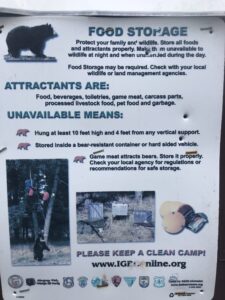
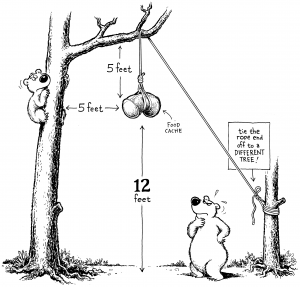
    First off consult the food storage order for the area you will be traveling.  In the Bob Marshall the food storage order specifies that for hanging food you must position your parcel so that the bottom of the food bag is 10′ from the ground and at least 4 feet from any upward support, ie. the tree trunk.

    To begin, here are some other food storage methods available if you don’t feel like messing with a hang or plan to be in an environment that makes hanging food to spec. pretty impossible.  I ran into this problem while working in the Sierra’s.  I was used to Montana’s pines, but when I got to California most of the trees were limbless till about 30′ up there and I had a hard time making an adequate hang.  It can also be difficult to make good bear hangs in alpine environments.

    Bear resistant containers are a great solution to this problem.  Barrels have long been the standard and can often be rented from your local gear shop or ranger station. Ursa sacks are a little newer to the market, but also meet the requirements of bear resistant storage.

    So back to the hang.  I like to carry parachute cord or something similar because it is both strong and light, relatively inexpensive and you don’t feel bad if you have to cut a chunk off if needed for something else.  I like to have about 30 – 50′ of the stuff.  I usually use an old stuff sack for my food bag.  It is a nice touch to have one that is water proof.  Make sure you have something you can close and that it has some type of cord or loop that will make it easy to attach to your rope.  Last bit is a small carabiner.  This makes it a lot easier to attach your food bag to the line and if you need to hang more than one bag of food, makes that simpler too.

    I like to hang my food a ways from where I am camping.  Take your time, go on a little stroll about the place.  It can be pleasant to make this a leisurely exploration of your camping area.  Pick out a few different spots.  Ideally you will find a tall pine that has a beefy branch sticking out into space. Perfect.  Or maybe you will find a steady tree that is leaned over.  Or maybe your 6th grade geometry will kick in and you will find yourself securing one end of your rope to one tree and then wrapping it around another to span between two uprights.  Things may need to get creative.  But that’s not a problem.  That’s the fun part.

    Getting it up there.  One of the reasons I like p-cord is because I think it makes the toss up easier than a heavier line.  Find yourself a baseball size rock, tie your line to it, then give it a few wraps.  Remember to hold onto the tail end of your rope, then give it a toss.  Gold star if you can get it in the first attempt.  Once you recover the hanging end, make sure the line is far enough away from the tree.  If it’s not, give it some waves and walk it further out.  Attach your food bag with the carbines and hoist’er up there.  Tie off your tail end to a low branch or trunk of a different tree. The illustration below shows a proper bear hang set up. 

    Picture courtesy of NOLS Cookery (National Outdoor Leadership School) (NOLS Library) Kindle Edition by Claudia Pearson (Author, Editor), Mike Clelland (Illustrator), Stackpole Books; 5 Revised edition (January 1, 2004)

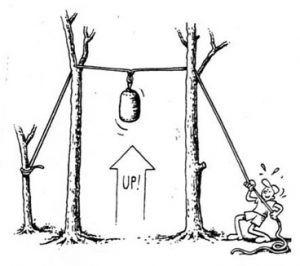
    At higher elevations, where the trees are shorter you might find yourself having to do some climbing and having to run your bag on the span between the two trees.  If this is the case it is helpful to tie a loop in the middle of the span so you can more easily clip your carabiner to the middle of the line. The following illustration shows an example of the two tree bear hang: 

    Illustration by Mike Clelland


    Check out some of our silly bear hang antics here: treeclimbingincrocs

  • Morgan’s Internship Experience with MARS Wildlife Rescue Centre

    Morgan’s Internship Experience with MARS Wildlife Rescue Centre

    by Ali Morgan, a staff member and guide with Dropstone Outfitting

    MARS Wildlife Rescue Center –  Vancouver Island, British Columbia

    Many people right now are experiencing something that I have some familiarity with: Being at home with arguably too much time available. In the past, for me, it has been time between seasonal jobs and much more of a choice compared to the current shelter-at-home requirements.  Right now I have a bit of time to write this blog because I’m self-quarantining at my home in Choteau after returning from an internship at MARS Wildlife Rescue on Vancouver Island, British Columbia. My goal there was to do something different, something where I could learn and experience something completely new.  MARS certainly delivered!

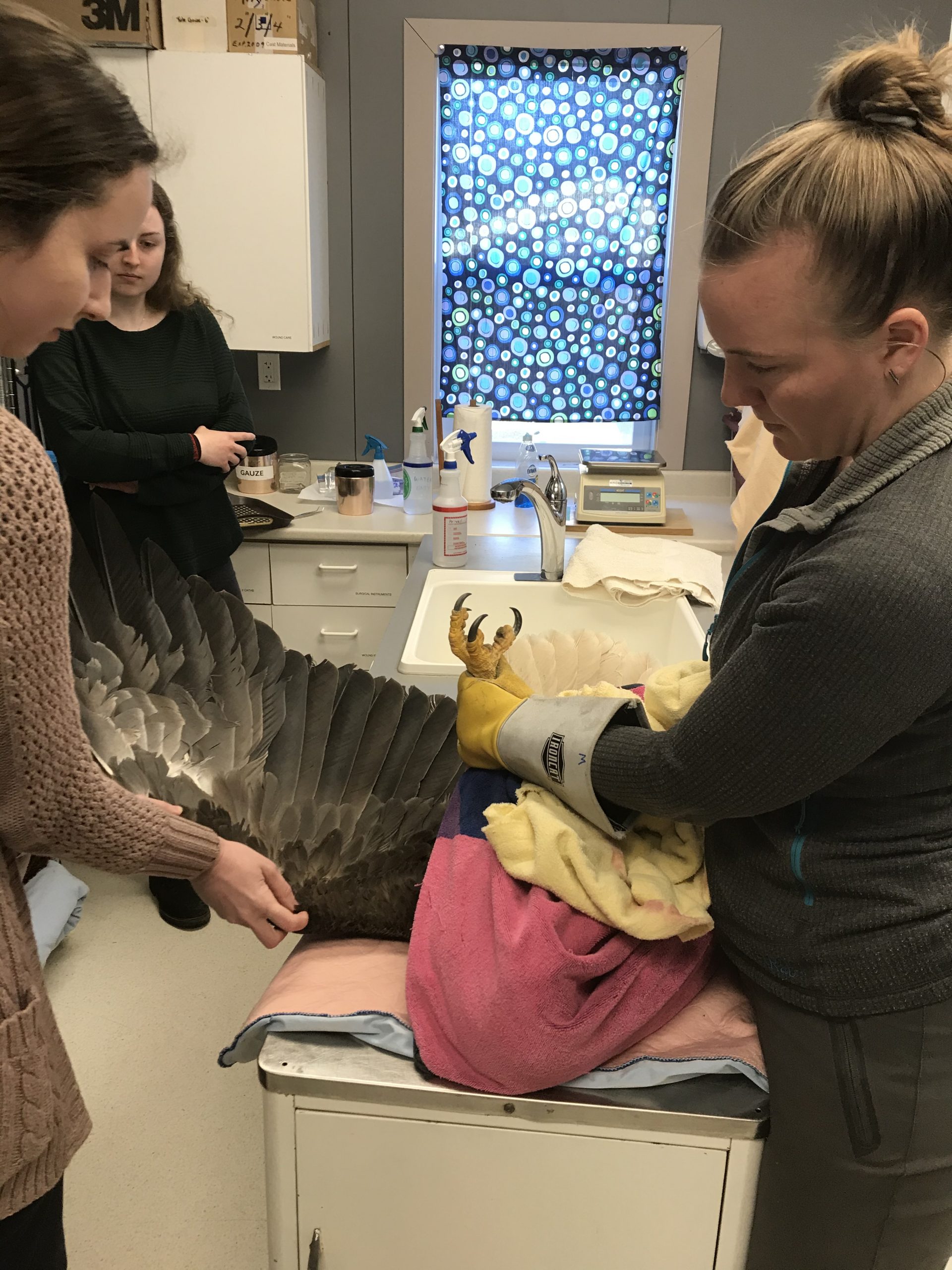
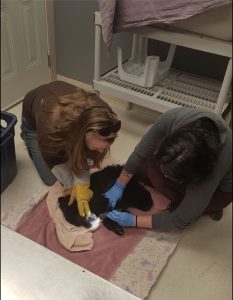
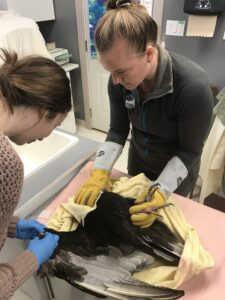
    MARS has an incredible visitor center that educates the public about what they do and how everyday people can make a difference towards ensuring the safety of their local wildlife. At the MARS hospital, where I worked, we rescued injured or orphaned wildlife, with the mission of rehabilitating and returning to the wild as quickly as possible.  We took in a variety of critters while I was there from raccoons, otters, squirrels and even a baby bear.  The majority of MARS’s patients, however, were birds.  Most smaller had flown into windows, been attacked by domestic animals, or poisoned by bird feeders that are not kept clean enough.  But by far the majority of birds at MARS, and what MARs is most known for is eagles. 

    While it can be hard to describe a typical day in the hospital at MARS, in general we meet in the morning and go over all the patients, decide who will be assigned where, and begin. Sometimes there were 10 of us between staff, interns, and volunteers, other days just 3.  Some days we took care of our patients and were able to help work crews with landscaping projects or other back logged needs, while other days we went out on several rescues, or released some of our healthy critters.  Often it stretched out to be a very long day.  One thing is sure though, there is always something to do at MARS. It may be anything from dishes, laundry, hauling pea gravel, scraping eagle poo, organizing freezers, or the endless preparations for baby season. You may think scraping poo does not sound like much fun, but when you get rewarded by being so close to these incredible animals, seeing them everyday, and eventually releasing them back into the wild, it is all worth it. 

    We saw a fair amount of owls coming in after getting hit by cars, and until I came to MARS I never realized how I had personally put owls in danger by something I think most of us do pretty frequently. If you are familiar with owl anatomy, then you know that they can not actually move their eyes at all. They are in a fixed position in their skull, which is why they have adapted to having 12 vertebrae and can turn their heads so far around. Because of this, when they identify prey, a mouse for example, they lock onto that target without seeing anything in their periphery. So when you innocently throw even biodegradable trash out your car window and think it will just disappear, you are actually endangering owls. Mice are likely to find that garbage, and it may so happen that an owl finds that mouse. Once he is in motion there is no way the owl will even see the car zooming towards him.

    Many of the eagles at MARS come in for lead poisoning, getting hit by a car, or a combination of both. It can be heartbreaking to see when they first arrive but the upshot is that we were able to re-release most of the birds after treatment.  It’s a completely preventable issue that, with education we may be able to solve.  And it’s not just a Canadian problem, it is very much a US problem as well.  The two primary ways eagles get lead poisoning are ingesting tiny fragments of lead left in carcasses by hunters or from eagles eating lead poisoned ducks who’ve bottom fed on lakes where 30 year old lead shot (because, like the US, using lead shot in Canada has been illegal since the 90’s) could still be sitting.

    Many of us, though, are still rifle hunting with lead core bullets. Up until the 2019 season I would include myself in this, however after seeing what I saw at MARS I will absolutely never use lead bullets again. After entering the body of your target, bullets can fragment into thousands of microscopic particles that remain in gut piles and are then easily ingested by eagles. Because they have such a fast metabolism it effects them very quickly and is commonly fatal. Before becoming completely lethargic however, the eagles can struggle along for some time, while their reaction time becomes delayed. This is probably why we rescued so many birds after getting hit by cars, and come to find out after testing that many are also lead poisoned. I don’t think any of us would poison our national bird on purpose, and I for one already have my copper bullets ready for next season. I wish I could tell you that the tiny lead particles don’t effect them much, and they can pull through on their own if they just eat a small amount, but that is just not the case.  Some of these birds come in completely defeated, unable to stand or hold their head up. They can not eat and become completely helpless, it’s no wonder they resort to rotting carcasses on the highway and then can’t avoid getting hit by cars. I took blood tests and saw the lead levels for myself. One bird even continued to leach lead out of her bones after several weeks of treatment. As hard as it was to watch them suffer though, I also saw their power and will to live. Eagles are incredibly strong both mentally and physically and I can not imagine causing that kind of pain in another living thing, especially when it is so easily preventable.

    After coming home I can reflect on all the things that I learned at MARS, most of it being practical knowledge of animal anatomy and behavior, but I think my biggest take away is that by just educating my friends, and my community on these two issues we could really save a lot of lives! Working with MARS was a great experience but it would be great to live in a world where we don’t need facilities to take care of the wildlife that is injured due directly to humans. 

          Lastly, I will close out by saying that MARS is truly an incredible place, completely dedicated to these animals, and they are getting hit very hard by the covid disaster. They rely heavily on volunteers and donations to stay afloat, both of which they are lacking with more people staying home and less capacity to fund raise. In addition lead treatment is expensive, and baby season has arrived! They will likely be short on supplies to keep all the critters healthy and happy. So if you are interested in learning more or making a donation please visit; https://marswildliferescue.com/

  • Dropstone Outfitting LLC Covid-19 Policy

    Before Your Trip

    • Keep up the good work! Practice thorough personal hygiene and social distancing to keep yourself healthy. 
    • You will be required to complete a short health screening and return it to us 7 days before your trip. We will again do a screening upon your arrival to determine your level of COVID risk. Any person displaying signs of illness, including a temperature of 100 F or over, will be unable to join us on the trip. Please be respectful of others, and if you are feeling unwell, do not participate in the trip. 
    • You will need to bring your own personal hand sanitizer, cloth face mask, soap, and towel (for hand washing and personal use). Unfortunately, biodegradable soap is not sufficient.  Please bring the liquid or bar soap you have been using from home.  
    • Pack your gear in a trash bag/s. We will be packing your personal items in duffels we provide. Daily disinfecting of the outside of the duffle bags will be part of our procedure and we don’t want your gear getting damaged by our disinfecting alcohol solution.  
    • We will be gathering the evening before the trip for an orientation.  We will still provide dinner; however, all meals will be plated. If you do not wish to stay in a hotel the night before the trip, we can recommend several campgrounds.

    Our Pre-Trip Practices: 

    • We will thoroughly disinfect any group gear (cookware, water filtration systems, tables, duffle bags, chairs, rented tents/sleeping bags/pads) between trips.
    • We will disinfect the entire van. 
    • We will bring additional hand sanitizer and sanitizing wipes into the backcountry.
    • We will monitor our health regularly. Any staff member displaying signs of illness will be removed from daily operation. We will follow the current public health protocol to determine the next step if a staff member tests positive for Covid-19.
    • We will be using additional safety measures while food shopping and meal prepping including frequent disinfecting, hand washing, and the use of cloth masks. 

    On the trip: 

    • Everyone is required to wear a cloth mask in the van. Please hand sanitize before and after van ride. 
    • Each backcountry camp will have two hand washing stations. One at the latrine and one near the kitchen. All participants will wash hands when leaving camp, coming back to camp, after using the restroom and before cooking or preparing any meals.
    • We will also have a hand washing station at lunch for you to use. 
    • Only staff is allowed in the kitchen area and food boxes. We will plate, package, pour and serve all food. You may only handle your own food. 
    • At the beginning of each day, you will be given a brown paper lunch bag with your lunch (you will dictate to us what you would like in your lunch). At the end of each day, we will burn these bags. Anything that you do not eat that day must be thrown away.
    • We will make an alcohol solution fresh daily to spray down all duffle bags before packing them together. Duffle bags will be provided. 
    • All dishes will be soaked for 30 seconds in bleach solution before drying.
    • All shared surfaces will be disinfected at the end of every day (tools, tables, other gear).
    • Spouts of group water jugs will be disinfected regularly.
    • NO sharing of personal food, water bottles or utensils.
    • We will adhere to social distancing standards on the trail and in camp. 

    Responding to Illness or COVID-19 Symptoms in the Field & Evacuation

    • Everyone must disclose any illness or COVID-19 symptoms prior to starting a trip or during a trip. 
    • Anyone exhibiting signs of any illness while on the trip should alert staff and immediately self-quarantine in their tent while symptoms are monitored and the person can be evacuated.
    • Self-Isolate the member exhibiting symptoms of fever, cough and trouble breathing and begin making plans to evacuate. Staff will notify the county dispatcher and the Forest Service. 
    • Affected individuals should wear a mask at the onset of symptoms and anyone coming into close contact. We will carry a limited supply of N-95 masks for evacuation. 
    • When it is safe to do so, we will evacuate the patient. First priority is hiking out. If that cannot be done, arrange for a horseback ride out. Last resort is air evacuation.

    Thank you for your help in keeping us all healthy and able to enjoy the mountains this summer!  If you have any questions, please contact us at [email protected] or call (406) 289-0863. 

  • Social Distance in miles, not feet

    Social Distance in miles, not feet

    While the world is in an uncertain and ever-evolving place, we continue to move forward with our summer plans. A couple of factors keep us optimistic. We are lucky to work in one of the nation’s largest Wilderness Areas where space abounds. Our group sizes are small and the majority of our clientele lives within Montana’s borders. We have been discussing new policies to build upon our already robust safety, hygiene and food handling practices to keep our guests and staff safe.

    We also believe in better times ahead, and that planning a much-needed trip to the mountains might make our days a little brighter. We’re itching to get on the trail and breathe some mountain air during these unsettling times, and we know many of you are feeling the same.

    With that in mind, we’re still looking forward to our summer season, while knowing that we may still need to change our plans. However we move forward, we’ll continue to follow CDC and State guidelines for public health. This may include limiting our guests to only include Montana residents depending on travel advisories in place at the time of a scheduled trip.  You may wish to keep apprised of the State’s decisions as we move through this emergency, at https://covid19.mt.gov

    As we continue to navigate the times we have a few options for hitting the woods this summer that might fit well with your plans and comfort level.

    Montana Drop Camps – travel with friends, family or whoever you feel safe sharing your space with.  $1500 will get you a drop with 4 mule loads of gear up to 11 miles from the trailhead.  We will provide bear boxes and other support to help you plan a safe, easy and scenic mountain getaway.  Meet our packer at the trailhead where we will follow social distancing and CDC guidelines to pack and load your gear and get it all safely moved to your camp. Click below to learn more.

    Learn more about our drop camps
    Chinese Wall – What could be more memorable than spending weeks locked up in your house as the world suffers through a global pandemic?  Visiting The Chinese Wall in the Bob Marshall, of course.  We’ve added a Chinese Wall Trip to our line up, July 9 – 14.  This is a great opportunity to visit one of Montana’s epic natural wonders.
    Learn more about the Chinese Wall
    Space Available – Admittedly, we are anticipating cancellations in our future. But as space becomes available we hope to be able to fill those vacancies with interested folks from across Montana.  If this might be you, please email us and we will keep you in the loop.

    Even if we don’t get to see you this summer, we hope that you enjoy the season and are able to get out there and stretch your legs.  Everyone stay safe and if you have any questions or concerns please reach out.

    Cheers,

    Yve and Maggie

  • Montana Drop Camps

    Montana Drop Camps

    The Best Kind of Social Distancing

    Looking to stay close to home and explore your own backyard this summer? Hike in the Bob Marshall Wilderness of Montana—without carrying a heavy backpack—with Dropstone’s drop camp service that makes it easy for Montana families (and friends) to get outside, take a summer vacation and have a little break from all things COVID-19 while still adhering to social distancing practices. It’s a great solution for itchy feet and the growing wanderlust we all have. Plus, these summer trips provide Montana residents with a chance to spend time in one of the most beautiful places in the country.  

    As part of our drop camp offerings, we will pack your gear to a basecamp in the Bob Marshall Wilderness (we have many excellent recommendations) while you hike in. You can hike, hang out, fish and explore for as long as you like, and then we’ll come pick up your gear on a designated date.  


    What’s included:  

    • Three to four pack animals worth of gear. Each animal can carry 120 pounds of gear ( bulk dependent). 
    • Bear boxes. Bear-resistant containers are mandatory in Montana’s wilderness, unless you plan on hanging your food. You must be able to hang food 10 feet off the ground and four feet out on a sturdy limb. Standard coolers are not bear resistant. 
    • Basecamp location recommendations. If you have a favorite spot in the area we operate, we can also take you there, but it must be within 11 miles of trailhead. 
    • Map recommendations. You can purchase a Cairn Cartographic map from us for $20. We will include a few day hike suggestions with map.
    • Camp shovel.
    • Small first aid kit. 

    Here’s the nitty gritty:

    — Base rate is $1,500 for a three to four mule drop. This includes pick up and drop off. Each additional animal after four is $150 per direction. If you need more than five pack animals, another packer is needed and will be an additional $300 fee per direction. Group size limit is eight people. 

    — A non-refundable $400 deposit and reservation form is needed to reserve your date. The balance is due the morning of departure.  

    — A guide may be available for an additional fee. Contact us for more info. 

    — You supply all of your own gear and food. We will provide bear boxes and are happy to help if you have any gear or food questions. 

    — We will meet you early on the morning of departure at the trailhead to go through gear and pack it up. As part of this, we’ll also be sure to adhere to all social distancing and sanitation practices in our interactions with you.  

    — We would prefer that you bring a communication device (an Inreach, Spot or SAT phone) in the event of emergency or the need to communicate something to us.

    — You are responsible for bringing maps/gps/compass. As you’ll be in Montana’s backcountry, it’s  important to know where you are at all times. You can purchase a Cairn Cartographic map from us for $20 which will include a few day hike suggestions. 

    — You are responsible for carrying your own bear spray and for adhering to all food storage orders for the Bob Marshall Wilderness Complex.  

    — We will provide a camp shovel and will review how to properly practice human waste disposal when we meet you at the trailhead. 

    Contact us to learn more about these Montana drop camp trips and to inquire into date and location options . . .


  • Covid-19 updates from Dropstone Outfitting

    Covid-19 updates from Dropstone Outfitting

    Hello from Yve and Maggie.  No matter where you are, we hope you are well and able to get outside for a little nature therapy (with appropriate social distancing measures of course).  We have found that exercise has been a mainstay in our daily need for “mental breaks” from the stress of all things Covid-19.   Also, our awkward dogs love it . . .

    We wanted to check in with you during this time of uncertainty and to assure you we’re following Covid-19 news from the World Health Organization, the Center for Disease Control, and the Montana State Governor’s office daily.  Covid-19 is a new experience for all of us, and we are available and happy to answer any questions the best we can regarding the virus and your trip.  Many of you have probably been thinking about how all of this may impact your trip this summer.  At this point, we are remaining optimistic and preparing for our trips.  However, we want to be flexible because we do not know what will happen in the next few months.  The health and safety of you, our employees, families and community is the number one priority for us.

    A few updates about your trip:

    Because of the uncertainty surrounding the timeline and effects of the virus, we have made the following changes and updates to your Dropstone trip this summer. These are extraordinary circumstances that call for changes to our normal policies.

    1. The trip balance due dates for the all trips have been moved to a month before the trip start date.
    2. If we are forced to cancel a trip after the trip balance due date, we will refund your trip balance.
    3. We STRONGLY recommend trip insurance.  While there are limitations to what travel insurance will cover with covid-19, most will cover if you get sick with the virus and cannot come on the trip. DO NOT come on the trip if you test positive for coronavirus within a two week time period before the trip or if you are feeling ill. PLEASE read below about travel insurance.
    4. Cleanliness and sanitation have always been an important part of our daily routine both on the trail and off. With the arrival of Covid-19, we have ramped up our sanitation procedures even more and have made it a top priority in all areas of our operation. Additionally, we have been in touch with our state Outfitting and Guides Association about industry standards being developed for sanitation and infection control policies.  We will update you as we get closer to the trip date about what our procedures and policies are, what we are doing to enact them and what we may require of you.
    5. If your trip is scheduled early in the summer, and you would rather go on a trip later in the season, let us know.  As things are in flux, we may be able to get you on a different trip.

    As a courtesy to us, we ask two things:

    1. If you know that you will not be coming on the trip, please let us know sooner rather than later in the event that we can find someone to take your spot.
    2. Please buy trip insurance.  This is a way that may protect all of us from the financial hardship associated with covid-19.

    Travel Insurance Information

    –    If you have not gotten trip insurance, we strongly encourage you to do so.  There are several good options out there including World Nomads, TravelGuard and Global Rescue’s IMG Signature Travel Insurance.  Purchasing trip insurance is a step that may protect all of us from the financial impacts of the virus. ****Below are a few key take-aways from our current understanding on some of the policies available, but it is up to you to make sure you understand the coverage in your policy.***

      • World Nomads is one of the few insurance companies that does not have a pandemic exclusion.  It is still available for you to purchase even if you put a trip deposit down months ago. Plans cover if you, a travel companion, or  (in some cases) a loved one gets Covid-19 or are quarantined and you can’t travel as a result. In some cases it may cover if a doctor deems it medically unsafe for you to travel.  Similar to all of the plans that are not “cancel for any reason”, coverage does not include fear of getting sick or trip cancellation or interruption because of travel restrictions or closures in place because of Covid-19.  
      • The medium grade TravelGuard and regular IMG Signature Travel Insurance covers trip cancellation if you contract COVID – 19 before the trip and are unable to participate. You can still sign up for this policy even if you paid trip deposit months ago. (Disclaimer – each individual should check with their policy to understand the specifics of this coverage).  These policies will not cover fear of getting sick or travel restrictions or closures in place that may affect your ability to travel to Montana or for Dropstone to operate our business.  
      • “Cancel for any reason” policies — TravelGuard and IMG Signature Travel Insurance have “cancel for any reason policies” which are the most comprehensive in regards to COVID – 19 coverage. TravelGuard may cover up to 100% of your trip if you purchase “cancel for any reason” as an add on, although this is also the most expensive plan. These policies are still available even if you signed up for the trip in December and have not gotten insurance yet. IMG Signature Travel Insurance Plus will usually cover up to 75%, but it must be purchased within 20 days of initial deposit. If you signed up for a trip several months ago, then this option is not available.

    As we continue to learn more about the novel coronavirus and the timelines associated with social distancing, we will update you to how it may affect your trip. Flexibility and communication will be our guiding principle through this time of uncertainty, so please do not hesitate to contact us with any questions or concerns.  We will update this blog frequently, post any new information on Facebook, and keep you informed via email and phone.


    We are working hard to provide safe, fun outings this summer.  A little fresh air, relaxation, and adventure in the Bob Marshall Wilderness will be the perfect reprieve from all things corona.  

    We wish you health, sanity, and safety —

    Maggie and Yve


  • Layering Your Clothing for Variable Weather

    Layering Your Clothing for Variable Weather

    Naked Apes need to layer up . . .

    naked ape

    As a kid heading out to play, my parents would always yell at me to layer up.  I had no idea what they meant but as time went on, it finally began to sink in.  Living in Montana the weather can be variable and so can the activity.  Being able to add or subtract clothing (or layers) keeps you warm and comfortable.

    Even in the summer, mornings and evenings in the mountains can be nippy and you will start the day’s hike bundled with a hat pulled down and your collars popped.  But as the day warms up or you begin to churn up that steep mountain pass, you might find yourself sweating in your shirt sleeves.  All this in only a manner of minutes.

    This is where layers come in and why they are important.  Layering clothes helps keep you comfortable throughout the day.  The ability to take off and put on clothes and switch up the combination of layers will keep you out there and enjoying the scenery much longer.  I have a joke with my dog as we hike along and I continue to stop to put on clothes or take them off and he stops and patiently looks at me while seeming to say, “ Jesus lady you’re stopping again?!” as I dig into my bag to pull out a fleece.  “Heh,” I reply, “I can’t help it I’m a naked ape.”

    So with that concept in mind, here are some layering basics….

    No matter the season you got your base layer.  This is what goes next to your skin.  Clothing has come a long way since the cotton t-shirt so you got all kinds of options out there as far as material, just make sure it’s something that is going to wick sweat away from your body, like wool or a synthetic not the comfortable cotton t-shirt.  I find this is more important during the colder seasons than the hot summer months.  You also want to pick something that isn’t going to rub or chaff as you sweat and move. This layer also tends to fit a little closer to your body to make it easier to pull things over and the key ingredient here….you also want your base layer slightly fitted so it is able to do its job and wick away moisture.

    This base layer is more crucial when being active in cold weather.  During cold temps you need that base layer to move sweat away from your body to keep from getting chilled. You will also want to wear a base layer on your bottom half as well.

    Next comes a mid-layer.  1 or 2 in your kit that can be worn in tandem is a good idea.  Wool or synthetic, you want them to be a lighter insulating layer.  A quarter zip long underwear top and a thin fleece can keep you pretty snug, especially if you are on the move.  The fleece is also great as it will keep you warm when wet and is quick to dry out. 

    An insulating layer – this can be a puffy coat, either down or synthetic and how puffy depends on the temps.  I also like to throw in a vest.  These are great layering tools and can help make several different combinations work depending on what you’re doing and how cold it is.  They are also great help with the sweet pillow you are going to turn all this stuff into at night.

    Layers


    Your shell – it doesn’t have to be a hard exterior but something that can buffet the wind and rain and if it’s really wicked totally keep the wind and rain out is your final touch.  I strongly recommend Gortex for waterproof protection. It is expensive but when you’re going to be out in wet environments for any real length of time you will quickly be grateful you have it.

    Similar rules apply to your bottom half.  As you already know you want to keep the basement as warm as the upstairs.  Normal wool long underwear usually works just fine if you’re moving.  There also some great fleece tights and if it’s really cold a few companies make some insulated pants that can be worn under a hard- or soft-shell pant.  

    In the fall and winter, I will also layer my socks and gloves.  Liners for both feet and hands help a lot with managing sweat and keeping all those digits from getting frosty.  In the country we live managing for wind can also be important.  I’m a big fan of scarves for this reason.  They can keep the wind off your neck and if things really start to whip, they help protect your face.  This is the same reason I like to wear coats with hoods.  Not only can it help keep you from losing heat out the top of your head, but it can help keep your face warm by sheltering it from gusts.

    layers

    So, there’s the basic formula.  For our recommended gear list please click here.  This will guide you through the basics of what to pack on an extended outing as well as what to carry in your daypack.  

    Like so many things, the only way to truly dial it in is through trial and error.  So, next time you head out, stuff a few extra things in your bag or in your car.  Once you get out there experiment with different combinations and see what works best for you, what’s comfortable, what you need to keep warm and all the different lovely ensembles you can create with what you already have.  And please, don’t worry about looking good, it’s more important to just be warm.